
TOOLS & JUNGLE MEDICINE
Amanita Muscaria
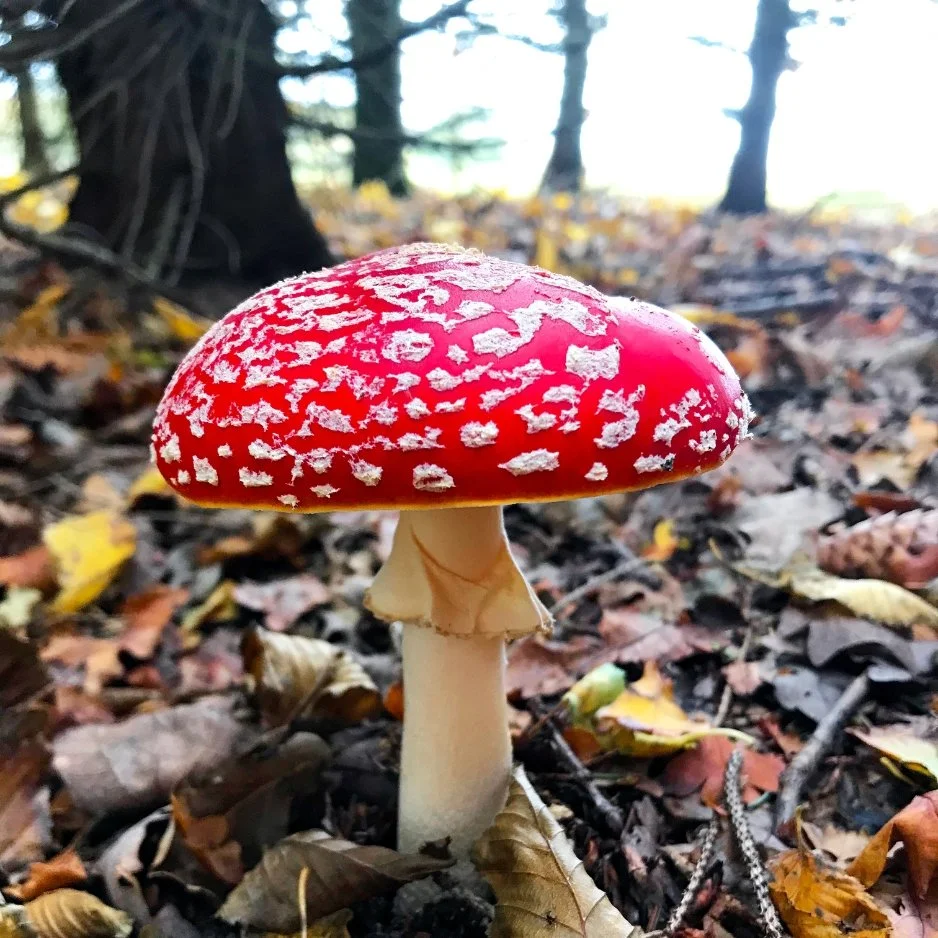
Long before psilocybin became a household word, another mushroom was already making its rounds through human history. Amanita muscaria, the red-capped mushroom with white spots, is one of the oldest and most recognizable psychoactive mushrooms in human history.
Its reputation as a poison mushroom comes largely from confusion with Amanita phalloides, the death cap, which is genuinely deadly. Amanita muscaria is a different creature entirely. In high doses, which we do not recommend (!), it produces a trance-like state, deeply inward, not the outward visions or revelations associated with classic psychedelics, but a radical turning toward oneself. In small, intentional doses, it is something else entirely.
Siberian shamans among the Koryak and Chukchi have worked with it for thousands of years, using it for divination, vision, and journeying. They observed that reindeer actively sought it out in the wild. They also discovered, practically speaking, that the mushroom's active compound, muscimol, passes largely intact through the body while the rougher elements are filtered out along the way. The urine, in other words, was cleaner than the original mushroom. History is full of surprising pragmatism.
It grows in symbiosis with tree roots, particularly birch, pine, and spruce. Not parasitic. Mutually nourishing.
How It Works
This mushroom contains two primary active compounds: ibotenic acid and muscimol. Through drying, ibotenic acid converts largely into muscimol. What remains is gentler on the system and less likely to cause nausea.
Muscimol binds to GABA-A receptors, the brain's primary inhibitory system. It turns the gaze inward. It doesn't amplify or accelerate. It stills.
The GABA system governs calm, sleep, and the nervous system's sense of safety. It also regulates the low-level vigilance, the rumination, the threat-detection that keeps us one step removed from ourselves. In microdoses, muscimol softens this layer. And in doing so, it creates space for something underneath to become more audible.
Muscimol reduces the noise of habitual self-identification, the mental constructs we have come to mistake for reality. What remains is closer to who you actually are.
There is a common assumption that more is better. A microdose slips beneath the threshold of resistance. It doesn't force anything. And precisely because it doesn't, it can go very deep, more slowly, more durably.
If you are not ready to truly see yourself, leave this mushroom alone.
Everything we describe on this page refers to microdosing. We recommend nothing else.
Commonly reported doses vary significantly from person to person. Each individual needs to find their own. Based on experience, they range between 0.1 and 2 grams per day. Higher doses of several grams we do not recommend under any circumstances. Amanita muscaria is not a mushroom to play with or add to a trophy list. It is fundamentally different from classic psychedelics. A high dose induces a trance-like, delirious state that can go seriously wrong without an extremely experienced guide holding the space. We recommend microdosing exclusively.
What people report: deeper sleep, clearer dreams, more space between impulse and reaction. Old patterns surfacing not to be relived but recognized and released. And something harder to translate, which is why we use the German word for it: Schaffenskraft. The energy that moves from inside out. The drive to create, to act, to be present in your own life. Not a new version of yourself. A clearer signal of the one that was already there.
Not Part of Our Retreats. Part of What Comes After.
Integration is about creating the conditions in which what you received in ceremony can actually live in you. Amanita, used with intention and awareness, can be a steady companion in that process. Accessible, gentle, and surprisingly deep.
Curious to explore this with guidance? Here's our 1:1 microdosing program.